Logistics
Reverse logistics, or the process of returning products for reuse, is a major source of carbon emissions - 24 million metric tons of CO₂ annually in the U.S. alone. Third-party logistics providers (3PLs) are tackling this challenge with smarter systems to reduce emissions by up to 30%. Companies like Riverhorse Logistics lead the way by optimizing routes, processing returns regionally, and prioritizing reuse over waste.
Key takeaways:
Quick Comparison:
| Feature | 3PLs (e.g., Riverhorse) | In-House Reverse Logistics |
|---|---|---|
| Emission Reduction | Up to 30% via optimized logistics | Higher due to inefficiencies |
| Cost Efficiency | Lower costs with automation | Higher costs (20%-65% of product value) |
| Scalability | Flexible for demand spikes | Limited by fixed resources |
For businesses handling high return volumes, 3PLs provide a more efficient and environmentally responsible solution while reducing costs and emissions.
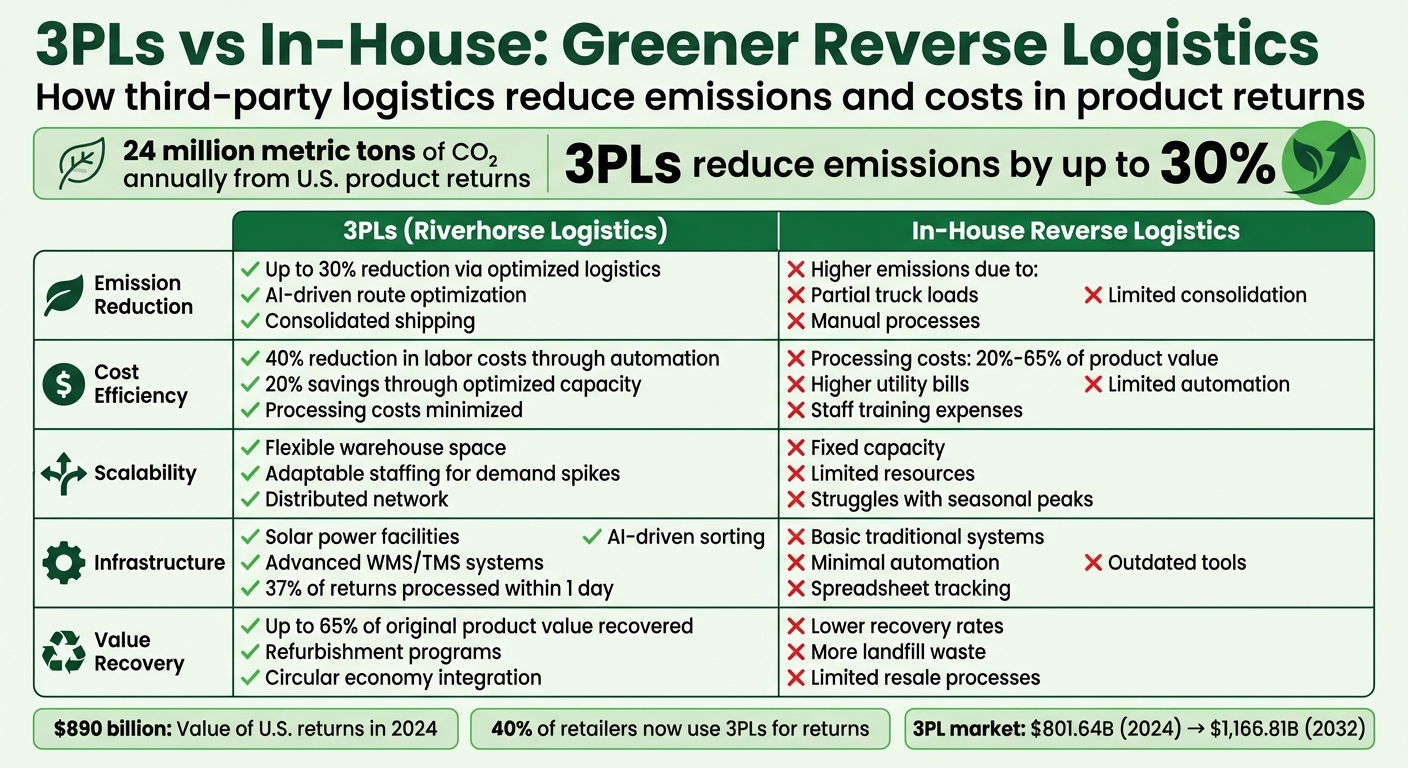
3PL vs In-House Reverse Logistics: Emissions, Costs, and Scalability Comparison
Riverhorse Logistics takes a proactive approach to cutting carbon emissions by focusing on regionalized return processing across its U.S. facilities. By using dynamic routing algorithms, the company consolidates shipments and eliminates unnecessary long-haul trips, slashing transportation-related emissions by up to 30%. Additionally, their intermodal transportation capabilities provide a fuel-efficient alternative to traditional long-haul trucking. To further enhance efficiency, Riverhorse employs an integrated Transportation Management System (TMS) that uses data-driven fleet management to optimize routes and minimize fuel consumption during return shipments. These efforts align seamlessly with their commitment to sustainable practices.
Riverhorse Logistics also prioritizes sustainability through its circular economy strategies. When returned items arrive, they are carefully inspected to determine whether they can be resold, refurbished, or recycled. This process not only diverts products from landfills but also recovers up to 65% of their original value. By implementing this structured recovery approach, the company reduces processing costs, which can typically range between 20% and 65% of a product's original price. It’s a win-win for both the environment and operational efficiency.
Riverhorse's proprietary shipment tracker provides real-time visibility into reverse logistics, ensuring transparency at every step. Their integrated Warehouse Management System (WMS) and TMS seamlessly synchronize data across ERP and shopping cart platforms, creating a unified system. By leveraging automation tools and self-service portals, the company reduces processing times and operational costs, making returns more efficient and less burdensome.
"We're proud to introduce a brand new e-Commerce fulfillment technology, all while creating more efficient business processes to support multi sales channel efforts." – Riverhorse Logistics
Handling reverse logistics internally often presents challenges that mirror those faced by third-party logistics (3PL) providers, particularly when it comes to environmental and operational hurdles.
Managing returns in-house can significantly contribute to higher emissions. A major issue is the lack of consolidation, which leads to trucks running partially loaded - or even completely empty - on return trips. This inefficiency adds to transportation emissions, which already account for about 28% of greenhouse gas emissions in the U.S.. Additionally, most warehouses still depend on manual processes due to limited eCommerce fulfillment technology. This slows down return processing and extends the time products spend in climate-controlled storage, further increasing energy consumption.
The financial side of in-house operations doesn’t help either. High costs often leave little room for investing in eco-friendly solutions like electric vehicles or renewable energy systems. These initiatives require substantial upfront capital, which must be absorbed entirely by the company. By contrast, 3PL providers can distribute these expenses across multiple clients.
Outdated tracking systems only make these environmental challenges harder to address.
In-house reverse logistics often rely on outdated tools like spreadsheets to monitor returned items. Without a modern Warehouse Management System (WMS), tracking becomes rudimentary, causing delays in returning items to sellable inventory and increasing waste.
This lack of technology becomes even more problematic when compliance with regulations is required. For instance, California's SB 253 mandates large companies to disclose emissions and climate-related financial risks. In-house operations often lack the advanced carbon reporting systems needed to meet these requirements. On the other hand, 3PL providers typically offer integrated systems that automatically track and report this data, making compliance far easier.
For nearly half (47%) of warehouse operators, managing returns is the single biggest operational headache. Processing a single return can cost anywhere from 20% to 65% of the product’s original price. These costs include hidden expenses like maintaining warehouses, higher utility bills for temperature-controlled storage, and hiring and training specialized logistics staff.
Customer loyalty is increasingly tied to sustainability. Over half (54%) of consumers say they prefer to do business with companies that prioritize environmental and social responsibility. Unfortunately, in-house operations often fall short of these expectations, especially when it comes to practices like refurbishment and resale. Without structured processes for handling returned items, these goods are more likely to end up in landfills rather than being reused or resold. This inefficiency stands in stark contrast to the streamlined, circular economy practices often implemented by 3PL providers.
Deciding between Riverhorse Logistics and handling reverse logistics in-house hinges on three key factors: reducing carbon emissions, cost effectiveness, and the ability to scale operations. Each option comes with its own set of benefits and challenges, influencing both your environmental goals and financial outcomes.
Here’s a breakdown of the main differences in sustainability and operations:
| Feature | Riverhorse Logistics (3PL) | In-House Reverse Logistics |
|---|---|---|
| Carbon Reduction | High; uses AI-driven route optimization and consolidated shipping to cut down on unnecessary mileage. | Lower; manual planning and less dense networks limit efficiency. |
| Cost Efficiency | High; automation reduces labor costs by around 40% and saves up to 20% through optimized capacity. | Lower; processing costs can range from 20% to 65% of the product's value. |
| Scalability | Flexible; adaptable warehouse space and staffing handle seasonal demand spikes. | Rigid; fixed capacity and staffing may fall short during busy periods. |
| Infrastructure | Advanced; includes solar power, AI-driven sorting, and a modern Warehouse Management System that processes 37% of returns within a day. | Basic; relies on traditional systems with minimal automation. |
The table clearly shows how 3PLs like Riverhorse Logistics outperform in sustainability and efficiency. Considering that U.S. consumers returned goods worth around $890 billion in 2024, the operational gap between these models directly impacts costs and carbon emissions. Nearly 40% of retailers now rely on 3PLs for returns, as these services use distributed warehouse networks to process returns closer to customers.
"Sustainability in logistics isn't just about switching to electric vehicles or using biodegradable packaging - it's about smarter, more efficient processes."
– Tansu Pancar, Project Management Professional
This level of efficiency becomes even more crucial when you factor in that returned products in the U.S. contribute over 24 million metric tons of CO₂ annually. These considerations play a vital role in determining the best approach to reverse logistics.
Studies reveal that 3PL solutions can significantly reduce carbon emissions in reverse logistics. With returned products in the U.S. alone contributing over 24 million metric tons of CO₂ annually, the way returns are managed plays a critical role in reducing environmental impact. Riverhorse Logistics tackles this challenge by leveraging AI-driven route optimization, strategically located regional return centers to cut transit distances, and circular economy practices that divert products from landfills.
Managing returns in-house can cost anywhere from 20% to 65% of a product’s value. In contrast, 3PL providers offer automation and load consolidation, which not only reduce costs but also drive efficiency. The 3PL market, valued at $801.64 billion in 2024, is expected to grow to $1,166.81 billion by 2032.
"Sustainability is not a cost - it is an investment in long-term growth and operational excellence."
– Christian Herc, Custom Goods LLC
For businesses aiming to lower their carbon footprint, partnering with Riverhorse Logistics offers immediate access to advanced infrastructure without the high costs of building it in-house. Their energy-efficient warehousing solutions, which can reduce facility costs by up to 30%, refurbishment programs that generate secondary revenue streams, and data-driven carbon reporting for compliance make 3PL partnerships a smart choice for sustainable business growth.
For companies managing high return volumes, Riverhorse Logistics turns reverse logistics into an opportunity to boost both sustainability and competitive edge.
Third-party logistics providers (3PLs) rely on cutting-edge data analytics, tracking tools, and standardized methods to measure and report CO₂ emissions from product returns. By utilizing warehouse management systems (WMS) and real-time tracking, they can closely monitor transportation and handling processes, ensuring emissions are calculated with precision. Additionally, many 3PLs produce detailed sustainability reports, enabling businesses to stay aligned with their environmental objectives while meeting increasing regulatory demands and consumer expectations for greener practices.
Products ideal for refurbishment are usually functional but may have minor flaws, like scratches or outdated components. Items such as electronics, home appliances, and other durable goods often fall into this category. By repairing or upgrading these products, they can be reused, which helps save resources and extends their lifespan.
On the other hand, recycling is more suitable for items that are non-functional, severely damaged, or of low value. These products are broken down into raw materials, such as metals and plastics, which can then be repurposed. This process not only reduces waste but also helps minimize the strain on natural resources.
Third-party logistics (3PL) providers play a key role here by evaluating returned items to decide whether refurbishment or recycling is the most sustainable path forward.
When return volumes grow beyond what your in-house team can handle efficiently, switching to a 3PL (third-party logistics provider) for returns can make a big difference. For example, in 2022, 16.5% of eCommerce sales were returned, putting significant pressure on resources and driving up costs for many businesses.
A 3PL can help by offering centralized facilities, advanced technology, and smoother processes. These features help cut down on errors, reduce warehouse clutter, and minimize delays. The result? Better customer satisfaction and improved operational efficiency.


.png)


