Logistics
Reverse logistics is a growing challenge for retailers, with U.S. e-commerce returns reaching $890 billion in 2024 and processing costs eating up to 66% of a product's price. Manual systems frustrate customers and slow operations, but automation tools are changing the game. These solutions reduce processing times by up to 50%, handle 80% of cases without human input, and even turn returns into revenue opportunities. Here's a quick look at seven tools that can streamline your reverse logistics:
These tools can help businesses save time, reduce costs, and improve customer satisfaction. Below is a quick comparison of their main features.

Reverse Logistics Automation Tools Comparison: Features, Pricing & Best Use Cases
| Tool | Key Features | Best For | Starting Price |
|---|---|---|---|
| Riverhorse Logistics | RFID tracking, ERP integration | All business sizes | Custom pricing |
| Outvio | Smart carrier selection, RevenuePlus | High-volume eCommerce brands | $125/month |
| ClickPost | AI routing, real-time updates | Mid-to-large eCommerce businesses | Custom pricing |
| Loop Returns | Instant exchanges, fraud detection | Shopify-based businesses | ~$155/month |
| ReturnGo | Automated workflows, bonus credits | Small to mid-sized eCommerce brands | $23/month |
| Revers.io | Recycling, supplier communication | Large enterprises in Europe | Custom pricing |
| ServiceCentral | Repair and warranty management | Repair/service operations | Custom pricing |
Automation tools like these can transform reverse logistics into a smoother, cost-effective process while improving customer loyalty. Choose the one that aligns with your business needs and test its features before scaling up.
Riverhorse Logistics blends cutting-edge warehouse management with comprehensive returns processing, operating across an impressive 1,300,000 square feet worldwide.
The backbone of Riverhorse's automation lies in its RF-based Warehouse Management System, created in partnership with National Science Foundation (NSF) research. This system efficiently manages RMAs and inventory tracking through the Intellitrack suite, which incorporates RFID tagging, barcoding, and automated labeling. These tools ensure precise tracking of returned goods from the moment they arrive.
By automating replenishment and offering real-time visibility for distribution centers and stores, the system eliminates the need for manual updates. As Riverhorse puts it:
"Logistics and supply chain management is useless without world class information systems to manage the processes".
Riverhorse prioritizes seamless integration throughout the supply chain using EDI, online communications, and real-time data synchronization. Their platform connects effortlessly with ERP systems, warehouse management software, transportation management systems, and even shopping cart platforms. This ensures that reverse logistics aligns smoothly with production and forward delivery processes. Additionally, businesses can leverage Riverhorse's NSF Cost Modeling Tool to set benchmarks, estimate storage needs, and choose the best storage solutions for their returns operations.
This robust integration enables Riverhorse to scale its services for businesses of all sizes. With a global footprint and an adaptable warehouse network, the company can meet the distribution demands of both small and large organizations. Riverhorse offers three tailored service tiers:
Each tier is priced based on volume and specific business requirements, ensuring a custom solution for every client.
Outvio transforms return processing into a revenue opportunity by automating tasks like RMA generation and label printing, saving businesses over 250 hours for every 1,000 returns processed.
Outvio’s smart rule system optimizes logistics by selecting the most cost-effective or eco-friendly carriers, flagging ineligible returns, and prompting users to upload damage photos when necessary. Its self-service portal, available in over 30 languages, significantly reduces customer service inquiries - by as much as 93%.
The RevenuePlus feature turns refunds into instant exchanges or product upgrades. For example, Popa Brand saw a $200,000 revenue increase thanks to this system. Marketing Director Patricia Gabarrón shared:
"Our customers are really happy with the return process; they often end up spending more than they intended to return".
These automation tools are designed to integrate smoothly with existing systems, ensuring a streamlined experience.
Outvio’s integration capabilities are central to its effectiveness. The platform supports connections with over 100 carriers and leading eCommerce fulfillment platforms through pre-built, no-code integrations. For custom requirements, a detailed API facilitates bi-directional data flow with ERP, WMS, and TMS systems. This centralized approach has enabled businesses to process shipments 300% faster without errors.
Outvio’s modular platform caters to businesses of all sizes. Smaller brands benefit from features like automated label generation and easy carrier integrations, while larger enterprises can take advantage of advanced tools such as AI-powered refund manipulation detection and a built-in help desk - all accessible from a single dashboard. For logistics providers, there’s even a specialized 3PL tool for managing multiple client accounts.
The platform’s design grows with your business, making it a flexible solution for reverse logistics. Pricing starts at $125 per month, with enterprise plans costing around $4,500 annually, and a 14-day free trial is available.

ClickPost simplifies reverse logistics for high-volume direct-to-consumer (DTC) brands. By converting 54% of returns into exchanges and encouraging store credit incentives, it helps businesses retain 40% of revenue.
ClickPost's flexible rules engine automates return approvals or rejections based on factors like eligibility, item category, and customer segment. It also generates pre-paid return labels and selects cost-effective carriers by analyzing location and service level. Its AI-powered system categorizes returned items for restocking, refurbishing, recycling, or scrapping, ensuring seamless routing to the right facility without manual intervention. This level of automation can cut operational costs by up to 30%. Plus, real-time updates sent via email, SMS, and WhatsApp significantly reduce customer support tickets.
Nakshatra Jain, Associate Product Manager at Curefit, shared:
"The experience on the Returns & Exchange module has been really good, every process is transparent. The UI is very agent friendly and can be used by non tech people, hence making it scalable."
This robust automation integrates smoothly with existing systems, enhancing overall efficiency.
ClickPost serves as a centralized intelligence layer, linking WMS, OMS, ERP, and TMS systems through APIs. This integration automates shipment creation directly from ERP documents, eliminating the need for manual data entry. With support for over 500 carrier partners and compatibility with major storefronts like Shopify, Magento, and BigCommerce, ClickPost consolidates fragmented systems, reducing errors and speeding up processes.
Sonali Das, D2C Tech and Product Head at Birkenstock, remarked:
"Working with the ClickPost team has always been a great experience for Birkenstock. What I love about this team is that everyone is extremely knowledgeable about the system and how it integrates with other systems."
These integration capabilities are key to the platform’s ability to scale effectively.
ClickPost is built to handle the needs of mid-to-enterprise-level eCommerce businesses, especially those managing multi-warehouse operations and complex return policies. Its Policy and Eligibility Engine offers precise control over refund triggers, tailored to various geographies and customer segments. While smaller brands might find the setup process demanding, businesses experiencing growth benefit from admin-level controls that adapt to rising order volumes. The platform also provides custom pricing based on shipment volume and features, along with a free trial for testing.
Loop Returns takes automation in reverse logistics to the next level, transforming the traditionally cumbersome returns process into a revenue-generating opportunity. The platform has already helped merchants retain over $2.4 billion in sales by encouraging exchanges instead of refunds. Impressively, it handles 2 million returns monthly for 5,000 brands across 18 countries.
Loop's automation tools simplify returns for both customers and merchants. Through a branded self-service portal, customers can initiate returns on their own. Behind the scenes, a no-code workflow editor automates processes based on factors like product type, customer loyalty, order value, and return reasons. For example:
The platform also streamlines logistics by generating return labels or QR codes and performing cost-saving rate comparisons across 30+ carriers. Items are routed intelligently - whether to warehouses, store locations, resale partners, or donation centers - based on their condition and restock potential. Fraud detection is built in, flagging high-risk returns automatically with Loop Intelligence. All these features integrate seamlessly into Loop's broader ecosystem, ensuring a smooth process from start to finish.
As a Shopify Premier Partner contributing to over 15% of Shopify's total GMV, Loop integrates with more than 120 technology partners. It connects to ERPs like NetSuite and Microsoft Dynamics and WMS solutions such as ShipHero. Whether through one-way or two-way integrations, the platform enables data exchanges via real-time webhooks. These notify external systems of events like "Return Created" or "Label Generated", automating tasks like RMA creation and inventory updates. For enterprise clients, a public API allows for custom integrations tailored to specific needs.
Loop Returns goes beyond standard automation with features designed to boost revenue and operational efficiency. For instance:
On the environmental side, Loop has helped merchants save $4.8 million in shipping costs through consolidation and "Keep Item" workflows over the past year. Donation workflows and consolidated shipments also reduce waste, preventing items from ending up in landfills.
Security is another priority. Features like Single Sign-On (SSO), Two-Factor Authentication (2FA), and SOC compliance ensure enterprise-grade protection. For businesses transitioning from manual processes, the benefits are clear: small businesses see an average 22% increase in customer lifetime value, while mid-sized businesses save around $3,400 in customer experience time during their first year.
ReturnGo simplifies reverse logistics with a straightforward Trigger > Condition > Action workflow, automating repetitive tasks throughout the returns process. Its features handle everything from approving requests - based on criteria like first-time returns - to issuing refunds for validated or in-transit items. Once all policy steps are completed, RMAs are automatically closed, ensuring an efficient cycle.
Through its self-service portal, customers can initiate returns, specify reasons, and select resolutions - all without assistance. For example, in 2023, Travelpro, a luggage manufacturer, reduced its processing time from 20 minutes to just 90 seconds per return. Mark Costigliola, eCommerce Operations Manager at Travelpro, shared:
"The return process is completely customer-centric. They fill out the request, generate the label, and get a refund."
– Mark Costigliola, eCommerce Operations Manager, Travelpro
This automation lays the groundwork for seamless system integration.
ReturnGo’s open REST API connects effortlessly with various eCommerce tools, including WMS, ERP, 3PL providers, and helpdesk platforms. This integration ensures warehouse systems are updated automatically when RMAs are created or items are restocked. For shipping, ReturnGo collaborates with over 50 carriers and platforms like Shippo and ShipStation, optimizing rates and selecting cost-effective service levels. One Project, a global fashion platform, used these integrations to create a fully automated workflow, from customer request to refund completion. CTO Shmulik Konforty highlighted that automation enabled their team to focus only on exceptions requiring manual intervention.
Beyond automation, ReturnGo includes features designed to drive revenue and promote sustainability. Its "Shop Now" option allows customers to browse and purchase new items directly through the return portal, while bonus credits encourage exchanges instead of refunds. Orthofeet, a footwear company, saw a 30% increase in exchanges after adopting ReturnGo. Co-Founder Ron Bar remarked:
"We saw an increase of 30% in exchanges when we switched to ReturnGo from a previous solution. It's a win-win situation both for our customers and us."
– Ron Bar, Co-Founder, Orthofeet
On the eco-friendly side, ReturnGo offers options like keeping or donating returned items, reducing a brand’s carbon footprint by 15%. On average, users report a 39% increase in retained revenue, a $1.95 boost in revenue per return, and $3.40 in logistics savings per return.
ReturnGo showcases how automation can create a smoother, customer-focused returns process while delivering measurable benefits for businesses.
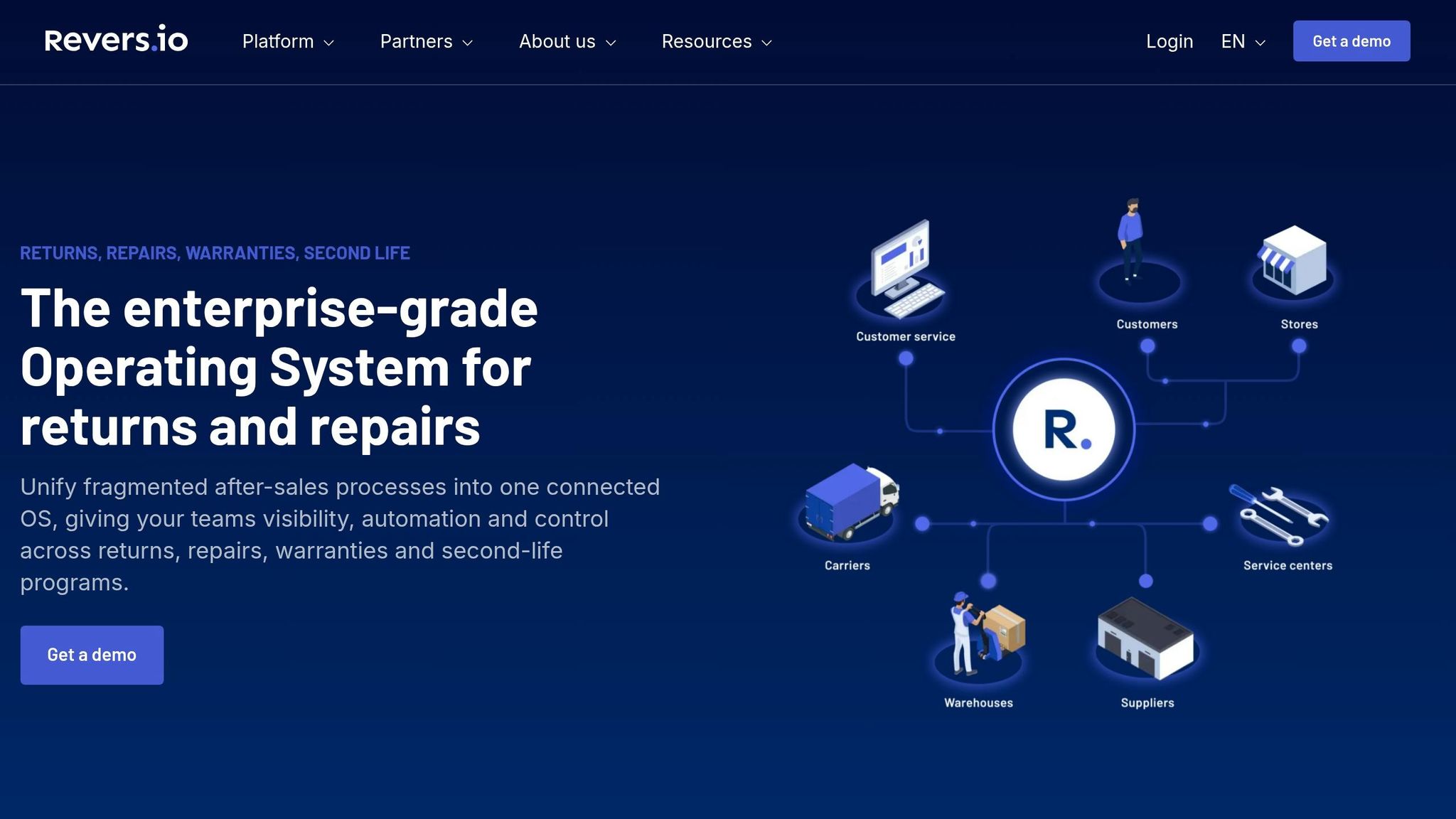
Revers.io serves as an enterprise operating system designed to simplify and automate customer returns, warehouse processes, and supplier communications. Through its self-service portal, customers can initiate returns or repairs, choose shipping options, and monitor the status of their returns - all without the need for human assistance. Behind the scenes, no-code business rules validate returns, issue instant refunds once a carrier collects a parcel, and direct products to the best destination, whether it’s resale, repair, refurbishment, or recycling.
Revers.io doesn’t just streamline customer-facing processes - it also transforms warehouse operations. Its "Scan and Go" feature removes the need for manual data entry. By scanning barcodes upon arrival, the system automatically fills in case details, performs quality checks, and closes RMAs.
Elem SA saw a dramatic shift in efficiency after adopting Revers.io. Michael Anzalone, the company’s After-sales Manager, reflected on the change:
"Previously, it would have taken us ten minutes to process each case during the week. Today, thanks to Revers.io, it takes us zero minutes to handle all of them." – Michael Anzalone, After-sales Manager, Elem SA
On the supplier side, the platform’s RMA automation speeds up administrative workflows with manufacturers, helping to secure faster credit issuance. For example, Boulanger implemented the solution in just weeks to address unpacking failures, achieving immediate cost savings thanks to streamlined supplier communications.
Revers.io integrates with over 450 partners, including manufacturers, wholesalers, retailers, and logistics providers, ensuring smooth data flow and eliminating silos. The platform offers standardized APIs for easy integration with ERP and WMS systems, while its dedicated RPA connectors support legacy systems. Key carriers like DHL, UPS, Chronopost, DPD, Geodis, and GLS are natively integrated, enabling automated label creation and real-time tracking.
Maisons du Monde, a retailer handling everything from small parcels to bulky furniture, uses these integrations to enhance its operations. Romain Lahoche, their Supply Chain Project Manager, praised the platform:
"Revers.io provides a self-care interface and an omnichannel experience that enable our customers to enjoy a seamless journey, whatever the context. What's more, the solution perfectly suits all of our product types, from small parcels to very large bulky items." – Romain Lahoche, Supply Chain Project Manager, Maisons du Monde
Warehouse integrations also give teams instant access to return reasons and product photos during inspections, helping improve logistical efficiency. These integrations pave the way for features that add even more value.
Revers.io’s "Second Life" module supports efforts to extend product lifespans by identifying items suitable for refurbishment or resale. The system generates detailed product listings, complete with grading and photos, for multichannel distribution. This approach not only maximizes resale value but also helps reduce waste.
To further enhance operations, the platform includes SLA monitoring, which tracks deadlines across suppliers, repairers, and carriers. It sends smart reminders or suggests alternatives when delays occur. For businesses managing repairs, direct connections with parts suppliers like SDS provide access to over 5 million SKUs, ensuring faster and more efficient repair processes.
ServiceCentral's ServiceManager is a tailored ERP platform designed to streamline processes like RMA creation, authorization, and routing through highly customizable workflows. Its intelligent routing algorithms pinpoint the most efficient locations and timelines for warehousing, repairs, and delivery.
ServiceCentral simplifies reverse logistics by automating key tasks. Its triage logic determines whether returns should be repaired, refurbished, replaced, or disposed of, based on predefined rules. This automation also extends to warranty and insurance claims, where the system handles claim collection, validation, and processing before services are delivered. Impressively, ServiceCentral tracks millions of products annually - ranging from smartphones and laptops to medical devices and airplane components - across thousands of service organizations in multiple countries.
Carlos Lafitte from Cooper General highlighted its impact:
"ServiceCentral's returns management solution enhances our overall operation process controls and provides business intelligence." – Carlos Lafitte, Cooper General
The platform also automates inventory tracking, ensuring parts and accessories are available for repairs or fulfillment without manual intervention. Thanks to its modular design, ServiceCentral can be deployed across various touchpoints like repair depots, retail stores, service centers, and call centers.
ServiceManager fills the gaps that traditional ERP systems often leave when it comes to handling complex service tasks. It provides a unified dashboard to manage multiple third-party partners, improving administrative workflows and boosting internal visibility. Teams can efficiently process services based on factors like region, product type, or triage results. This level of integration allows businesses to scale operations effortlessly.
Whether you're running a small operation or a Fortune 500 company, ServiceCentral adapts to fit your needs. It offers both hosted and on-premises installation options. Its modular suite grows alongside your business, addressing evolving demands across various service points. As G2 Reverse Logistics shared:
"ServiceCentral's ability to configure and customize their product to our needs allowed us to focus our efforts elsewhere and go to market faster." – G2 Reverse Logistics
ServiceCentral plays a vital role in supporting the circular economy by managing processes like refurbishment, remanufacturing, and recycling. Businesses can standardize workflows across their partner networks, simplifying quality assurance checks and ensuring compliance with regulatory standards for returns and repairs. Additionally, its self-service portals for both B2B and consumer users provide real-time updates, cutting down on support inquiries and fostering stronger customer loyalty.
Each tool mentioned earlier tackles specific challenges in reverse logistics, offering a range of specialized features. Riverhorse Logistics, for example, provides a comprehensive solution by combining warehousing, transportation, and returns management into one streamlined system. The table below summarizes the key features of each platform to help you identify the best fit for your needs.
| Feature | Riverhorse Logistics | Outvio | ClickPost | Loop Returns | ReturnGo | Revers.io | ServiceCentral |
|---|---|---|---|---|---|---|---|
| Primary Target | All Business Sizes | High-Volume DTC | Mid-to-Enterprise | Shopify Brands | Small to Mid-Sized eCommerce | Enterprise (EU) | Repair/Service Operations |
| Ideal For | End-to-end logistics & returns | AI-driven upselling | Carrier optimization | Revenue retention | Warranty management | Recycling & sustainability | Repair operations |
| Core Automation Capabilities | Returns management, ERP integration | Hands-free processing | AI fraud detection, multi-warehouse routing | Instant exchanges, returnless refunds | Pre-return triage | Label automation, recycling | Repair management |
| Integration Strength | WMS, TMS, ERP, shopping carts | Direct CMS & carrier integration | 500+ carriers | Third-party logistics providers, WMS, ERP | Open REST API | 450+ partners | Third-party service partners |
| Specialized Functions | Freight consolidation, cross-docking | RevenuePlus portal | Real-time tracking | Shop Now flows, bonus credit | Multilingual portals | Circular economy support | Product traceability |
| Scalability | Custom solutions for all sizes | Mid-to-large operations | Enterprise-level volume | SMB to mid-market | Small to mid-sized | Large European enterprises | Modular growth (hosted/on-premises) |
| G2 Rating | N/A | 4.8/5 | 4.7/5 | 4.7/5 | 4.8/5 | N/A | N/A |
| Starting Price | Custom pricing | $138/month | Custom enterprise pricing | ~$155/month | $23/month | Custom pricing | Custom pricing |
This breakdown offers a clear view of each platform's strengths, helping you match their features to your operational goals. For businesses managing an average return rate of 24.5%, automation tools like these can reduce processing times by up to 50%.
Choosing the right automation tool can turn reverse logistics into a key advantage for your business. The best solution depends on factors like your business size, return volume, and specific goals. For small to mid-sized eCommerce businesses, platforms like ReturnGo and Loop Returns stand out with their affordable pricing, easy integration, self-service portals, and exchange-first workflows. On the other hand, enterprise-level operations with complex needs often benefit from tools such as Riverhorse Logistics, ClickPost, or Revers.io, which offer advanced features like ERP integration, fraud detection powered by AI, and support for global carriers.
When evaluating tools, focus on ROI rather than just upfront costs. Consider the total cost of ownership, which includes setup fees, transaction costs, and savings from labor and restocking.
"A scalable reverse logistics solution eliminates fear of growth because you have a system that can handle it." - Gaurav Saran, CEO, ReverseLogix
Select tools that align with your business goals. For example, automated portals and real-time tracking are proven to boost retention - 92% of customers are likely to shop again if the return process is simple. To cut costs, look for features like AI-driven disposition logic, which helps determine whether items should be resold, refurbished, or recycled to maximize recovery value. If sustainability is a priority, platforms like Revers.io are worth exploring for their recycling and recommerce workflows that support circular economy efforts.
Before committing, test your shortlisted tools in a sandbox environment. Use dummy data to evaluate carrier API performance, label generation, and how well errors are handled. Roll out automation in phases - start small, perhaps with one return channel or product category, to measure results before scaling up. With online retail returns in the U.S. projected to hit 24.5% by 2025, totaling nearly $849.9 billion, these insights can guide you to improve efficiency and keep customers happy.
The starting point for streamlining your returns process is automating the initiation stage. This involves offering self-service portals where customers can kick off returns, create shipping labels, and select their reasons for returning items. By automating this step, you eliminate repetitive manual tasks, speed things up, and make the experience smoother for your customers. Plus, it lays the groundwork for automating later stages like processing, inspection, and final disposition.
To figure out the ROI for reverse logistics automation, you’ll need to weigh the financial benefits - such as reduced costs, better efficiency, and higher customer satisfaction - against all associated expenses, including setup, integration, and ongoing operational costs. The formula is straightforward: (Net Benefits ÷ Total Costs) × 100. Here, Net Benefits represent the total benefits minus all costs. By carefully accounting for every expense and the potential long-term savings, you can calculate a precise ROI.
To fully automate the returns process, it's crucial to connect your returns management system with essential platforms. These include:
By syncing these systems, you create a seamless flow of data, cut down on manual tasks, and boost overall efficiency in managing returns.


.png)


