Logistics
Wildfires now hit supply chains in three ways at once: sites shut down, freight routes close, and delays spread far beyond the fire area.
If I had to sum up the article in plain English, it’s this: the biggest wildfire costs often come from downtime and rerouting, not burned buildings. Research in the piece points to a $71.1 billion to $347.8 billion yearly U.S. wildfire burden, and one California fire analysis found 59% of losses were indirect. That means blocked roads, missed deliveries, power loss, smoke, and backlogs can do more damage to the business than flames alone.
If you run freight, warehousing, retail, manufacturing, or e-commerce, here’s what matters most:
A few numbers from the article stand out:
Bottom line: I’d treat wildfire as a repeat network risk, not a rare local event. The article points to a simple plan: harden sites, build route options, and make sure systems and teams can react fast when roads, power, or air quality change.
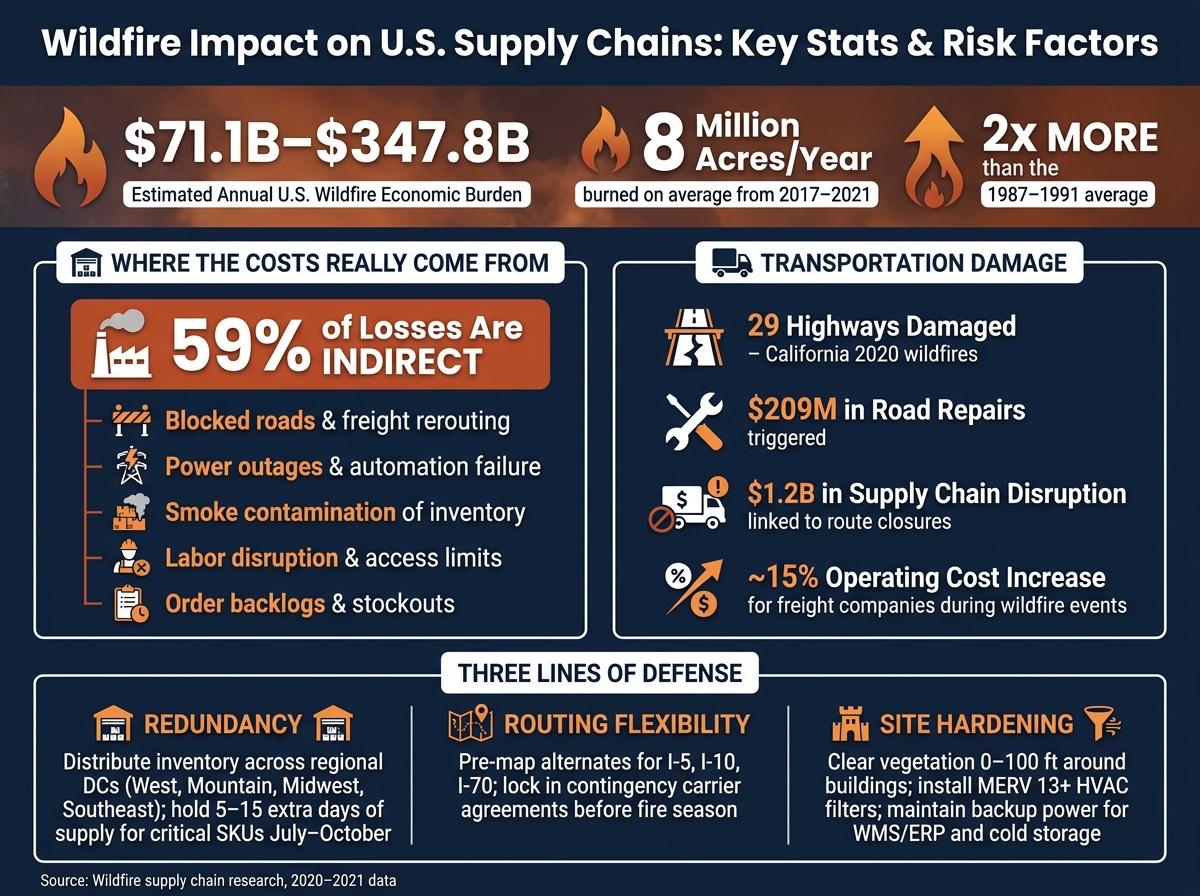
Wildfire Impact on U.S. Supply Chains: Key Stats & Risk Factors
At the facility level, wildfire disruption often begins with smoke, heat, and power loss, not direct flame contact. In plain terms, a wildfire can shut down a warehouse even if the fire never reaches the building.
Smoke is a bigger problem than many teams expect. It can contaminate food, pharmaceuticals, medical devices, and electronics. Residue can change odor and appearance, affect chemical stability, damage circuitry, and leave HVAC systems needing cleanup before a site can reopen.
Power outages add another layer of trouble. They can stop automation, refrigerated storage, and planning systems all at once. Backup generators help, but they usually support only part of the load, which leaves weak spots that can lead to spoilage and order backlogs.
The same issue spreads from facilities to the roads and rail lines that connect them. California's 2020 wildfires damaged 29 highways, triggered 35 repair projects, and led to $209 million in repairs. Closures on Interstate 5 and other routes were linked to $1.2 billion in supply chain disruption.
Rail service can slow down or stop when wildfire risk climbs. Railroads have suspended service on affected segments, rerouted trains, or cut speeds because of heat damage risk, smoke-related visibility problems, and worker safety concerns. Surveys of freight companies put average operating cost increases at about 15% during wildfire events, driven by extra miles, overtime, and empty repositioning miles.
The hardest part is that major fires often do damage far beyond the burn zone, and that damage may not show up right away. A supply chain can keep moving for a while on existing inventory, which hides the hit at first. Then the lag catches up: inputs run out, shelves empty, and backlogs start to build.
For logistics leaders, that delayed signal is one of the toughest parts to handle. It turns a visible fire event into a slower, less obvious business problem.
That pattern hits distribution centers especially hard, where access limits, inventory strain, and labor disruption all land at the same time.
Distribution centers and warehouses are high-risk nodes because they pack inventory, labor, and shipping coordination into one place. When one site goes down, the damage doesn’t stay local.
A lot of these facilities sit in light-industrial corridors near highways, rail lines, and ports. That setup helps freight move fast on normal days. But during a wildfire event, smoke and road limits can choke freight flow even if the building itself is fine. That’s when a wildfire shifts from a site issue to an inventory and service problem.
A Sacramento warehouse, for example, shut down after hazardous smoke from a fire more than 80 miles away reached the site. That kind of shutdown may look isolated at first. In practice, it can ripple across the whole network.
Just-in-time facilities are hit even harder because they have very little slack. Even short access disruptions can trigger stockouts. And many supply networks were built piece by piece over time, which leaves little backup when a key node fails.
Probabilistic wildfire risk models show a pattern that catches a lot of operators off guard: even when direct damage is rare, total costs can still climb fast if capacity is packed into a small number of nodes. One study found only a 0.1% drop in annual feedstock availability from wildfire damage to critical supply nodes, yet total supply chain costs still went up because the network had to deal with detours and unmet demand. A related analysis in the Inland Northwest found that processing-facility failures sharply increased transportation costs and lead times.
Network analysis points to another weak spot. Hubs near high-connectivity road segments face added risk because those corridors carry a lot of traffic and can turn into bottlenecks when closures hit. One disrupted node can send freight onto longer routes, strain less efficient facilities, and leave orders unfilled.
For operators with concentrated DC capacity in wildfire-prone regions, the next move is pretty clear: cut dependence on any single node. These weak points show where resilience work needs to begin.
Current research points to three main levers: redundancy, visibility, and site hardening.
Research leans hard toward redundancy. The idea is simple: spread inventory across regional DCs so one Western outage doesn't knock out service. Studies back distributed warehousing across regional DCs in the West, Mountain, Midwest, and Southeast. If a Western facility is hit, other nodes can pick up demand and help avoid a major service failure.
Routing flexibility helps with the same problem from another angle. Pre-map alternate lanes for I-5, I-10, and I-70, and lock in contingency carrier agreements before fire season starts. Backup options should include contract freight, spot capacity, and intermodal rail.
Inventory positioning is where seasonal planning starts to earn its keep. Research recommends higher safety stock for high-priority SKUs at downstream nodes from July through October, especially when upstream lanes pass through higher-risk areas in the West and Mountain West. Even a small buffer can make a difference. An extra 5 to 15 days of supply for critical items may help stop stockouts when access gets cut off.
Those buffers work best when teams spot a closure early and move loads before inventory dries up.
Plans can't sit still when closures, smoke, and power loss change by the hour. Real-time ERP, WMS, and TMS integration speeds up rerouting, load holds, and order prioritization. If a highway shuts down, a connected TMS can build alternate routing plans while the WMS holds loads headed into affected lanes and pushes forward orders that can still move through open corridors, all without waiting on manual steps.
Connected logistics systems give teams a faster way to reroute freight, pause affected loads, and shift orders through open corridors.
Technology helps, but coordination across teams matters just as much. Disaster management research supports a dedicated incident response team that brings together transportation planning, warehouse operations, and customer service. It also supports having pre-defined decision thresholds and communication templates ready before an event begins.
Customer communication is part of that response too. Early notice, before service is already disrupted, helps cut the uncertainty that leads customers to overorder and fuels the bullwhip effect downstream.
That kind of coordination falls apart fast if the facility itself isn't ready for smoke, blocked access, and outages.
Network resilience breaks down if the warehouse can't stay safe, powered, and running.
Defensible space is a practical place to start. Clearing flammable vegetation and debris in concentric zones, usually 0 to 30 feet and 30 to 100 feet around the building, lowers the risk of ignition from embers and radiant heat. Scheduled vegetation inspections, documented clearing intervals, and coordination with local fire authorities on water supply and access routes are all practical moves.
Smoke is a separate operational threat, and it can hit even when a facility is well outside the fire perimeter. Particulate spikes alone can force shutdowns. Installing MERV 13 or higher HVAC filters, sealing dock openings and building penetrations, and keeping positive indoor air pressure all help limit smoke infiltration at docks, cold storage areas, and order processing zones. Real-time air quality monitoring, both indoors and outdoors, gives facility managers the information they need to adjust work schedules or switch on stronger filtration before conditions turn unsafe.
Backup power and documentation round out the plan. Diesel generators or battery systems help keep WMS and ERP servers, cold storage, and safety systems running during grid outages caused by fire or preventive shutdowns. During an event, time-stamped photos, air quality readings, temperature logs, and downtime logs also support insurance claims, regulatory reporting, and post-season reviews that sharpen the response plan for the next fire season.
Put together, the research shows a clear change: wildfire risk is no longer just about damage at a single site. It now reaches across entire logistics networks. Fires last longer, hit more areas, and more often cross major freight routes. From 2017 to 2021, U.S. wildfires burned an average of about 8 million acres per year. That is more than double the 1987–1991 average.
The biggest costs usually do not come from flames hitting a building. They come from the ripple effects: delayed shipments, rerouting, and downtime. That’s the part that can throw an entire operation off balance.
Distribution centers make this risk even bigger. When one node goes down, the pressure doesn’t stay there. It spreads across the regional network and can jam up capacity in a hurry.
The research keeps pointing to the same three lines of defense: hardened facilities, flexible routing, and integrated visibility. Each one helps, but none can do the job alone.
A smart next move is a pre-season readiness review. That means checking which distribution centers, warehouses, and key suppliers are in or near high-risk zones, making sure alternate routing plans and carrier agreements are written down, and confirming that visibility tools are connected well enough to support fast calls when conditions shift. Riverhorse Logistics can help test wildfire readiness plans before fire season.
Wildfires don't need to hit a warehouse or plant directly to cause trouble. They can still jam up the supply chain by choking key transportation routes. Smoke, bad air, and flames near highways, rail lines, or port access roads can trigger closures, port backups, and last-minute schedule shifts that spread across the network.
The result is pretty simple: deliveries show up late, and costs go up.
This is where predictive analytics helps. It can flag risk 24 to 72 hours in advance, which gives teams time to act before a delay turns into a mess. That might mean rerouting shipments, moving goods into temporary storage, or switching to another transportation mode when the usual route isn't an option.
Wildfires often hit transportation networks and inventory availability first. When roads close or conditions turn dangerous, shipments get delayed and carriers have to change routes on the fly.
If fires reach areas with major distribution centers, stored goods can be put at risk. At the same time, bottlenecks can slow the flow of products to end users.
Before fire season, companies should focus on planning ahead and making their supply chains less fragile. Start by looking at the weak spots: transportation delays, route closures, and inventory levels that are too lean to handle disruption. From there, build a disaster recovery plan that covers emergency distribution, temporary storage, and cross-docking.
It also helps to avoid putting all your eggs in one basket. That means working with more than one supplier, using inventory systems to spot shortages before they hit, and connecting real-time data through a TMS so teams can react fast when conditions change. Working with Riverhorse Logistics can help shape these plans around your operation while helping secure capacity and alternate shipping routes.


.png)


