Logistics
I prepare for an FTZ customs audit by confirming CBP’s scope, matching inventory to records, and testing controls before the review. My goal: show where merchandise went, who approved each action, and how errors were fixed.
Here’s the checklist I use:
I also check the annual deadlines: at least 1 physical inventory each year, reconciliation within 90 days after year-end unless an extension is approved, and certification within 10 working days after completion.
My rule is simple: <u>a fix is not finished until I verify it</u>. For uncertain requirements or possible violations, I seek qualified customs advice.
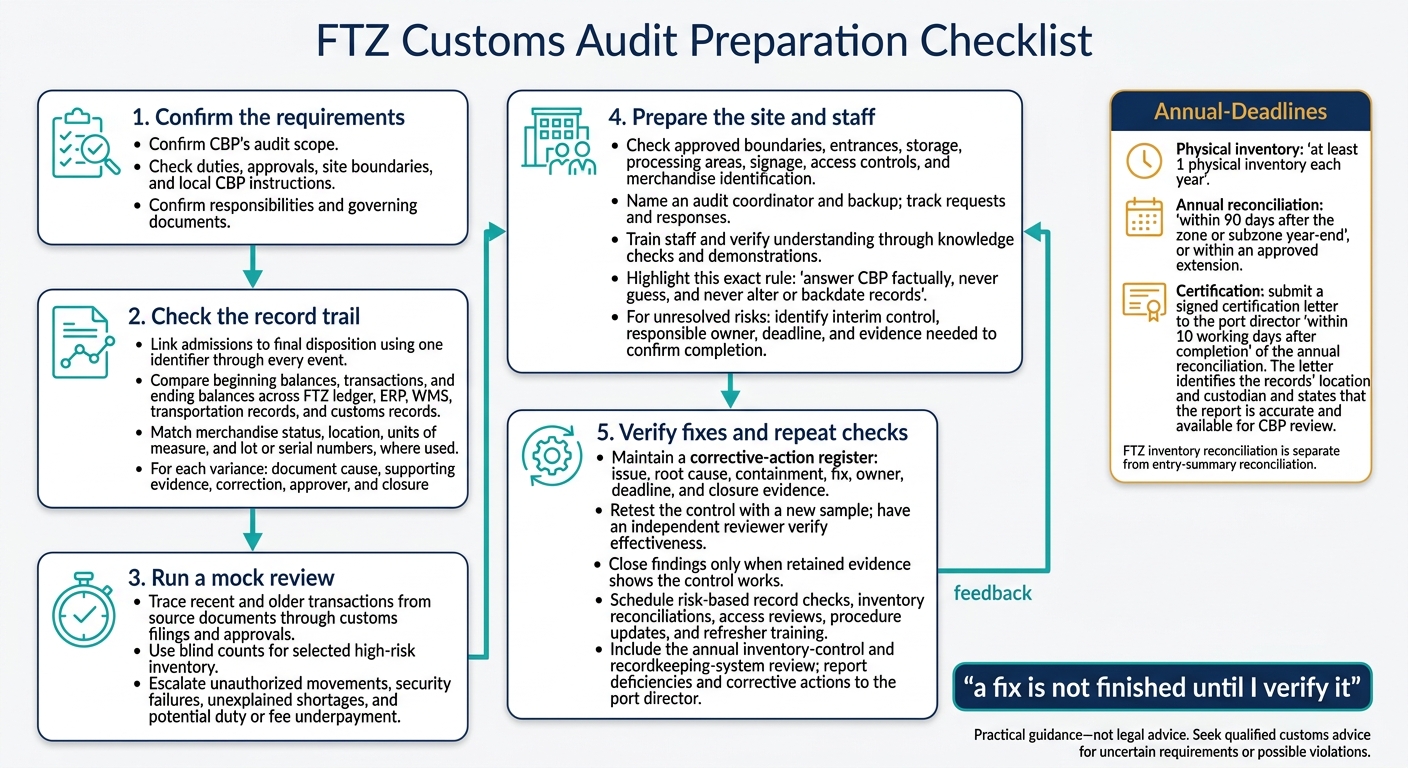
FTZ Customs Audit Preparation Checklist
With responsibilities and governing documents confirmed, build the record trail CBP will check first.
Create a master index that lets CBP follow each transaction from admission to final disposition. For each record, list its type, owner, system of record, date range, retention trigger, and retrieval method.
Cover admissions, transfers, removals, manufacturing, adjustments, destruction, FTZ status changes, and duty payments. Link customs forms, shipping documents, inventory and production records, proof of payment, site and approval records, operations and security records, prior findings, corrective actions, and CBP correspondence.
Assign one identifier at admission and use it through every event. This gives CBP an end-to-end merchandise trail. For goods entering U.S. commerce, link inventory depletion to the customs entry, entry summary, classification and value data, duty calculation, payment confirmation, and supporting commercial records.
Then check whether the books match the physical inventory and customs trail.
Compare beginning balances, transactions, and ending balances across the FTZ ledger, ERP, WMS, transportation records, and customs records. Match merchandise status, location, units of measure, and lot or serial numbers, where used.
Investigate posting errors, negative balances, and quantity differences. For each variance, document the cause, supporting evidence, correction, approver, and closure date. Preserve the original posting. For shortages or overages, record the quantity, description, tariff classification, zone status, and value.
Once balances match, check that staff can retrieve every record promptly and securely.
Check files for accuracy and completeness. Test retrieval by admission, lot, shipment, and entry number, and set an internal retrieval target.
For example, allow 10 minutes for routine electronic records; CBP does not set that retrieval target.
Confirm that exports are readable in formats CBP accepts, and preserve approvals and change histories. Restrict access by role, remove obsolete accounts, prevent deletion without permission, and test backup restoration.
Set retention periods by record type, rather than applying one period to everything. Follow the applicable FTZ rule and trigger date for each category. Hold records during audits, investigations, litigation, or contract disputes until released, and follow any longer applicable requirements. Tie retention rules to each record type so staff can produce audit files without delay.
Once records and inventory match, test whether your controls hold up under audit conditions. Build a written checklist tied to your FTZ procedures manual, 19 CFR Part 146, site authorization, and prior CBP findings. Test what staff actually do - not just what the procedures say.
Assign one review owner with authority to obtain records, interview personnel, coordinate physical checks, and track corrective actions. Cover transactions, controls, security, reconciliation, and discrepancies. For each test, record the evidence reviewed, exceptions, action owner, and due date. Use the same records and balances you reconciled in Step 1.
Sample both recent and older transactions, including adjustments, status changes, processing, destruction, and U.S. consumption withdrawals. Follow each transaction from its source documents and FTZ admission record through inventory records, ERP entries, customs filings, and approvals.
Check posting timing, movement and processing permissions, and unexplained losses. Where relevant, check classification, valuation, and duty calculations. Flag any user who can both create and approve adjustments.
Use blind counts for selected high-risk items so counters cannot see system balances. Check quantities, locations, identifiers, and merchandise status against the records. Confirm that the operator performs at least one physical inventory each year and investigates every count variance. Retain count sheets, recounts, and supporting explanations.
Compare the annual reconciliation with the inventory data reconciled in Step 1. Check that it was completed within 90 days after the zone or subzone year-end, or within an approved extension. It must show beginning quantity, receipts, transfers, ending quantity, and positive and negative adjustments by zone lot or unique identifier.
Confirm that the operator submits a signed certification letter to the port director within 10 working days after completion. The letter must identify the records’ location and custodian and state that the report is accurate and available for CBP review. This FTZ inventory reconciliation is separate from entry-summary reconciliation.
Log each finding with a unique ID, requirement, condition, cause, affected merchandise or records, risk, owner, corrective action, due date, and verification date.
Promptly escalate movements made without permission, security failures, unexplained shortages, and potential underpayment of duties or fees. Determine whether each issue calls for an amended or replacement filing, an inventory adjustment, notice to the port director or appropriate authority, or additional legal or customs advice.
Retest the control with a new sample. Close the finding only after retaining evidence that verifies the correction.
After the mock review, confirm that the facility still matches approved FTZ operations. Walk through the site with the approved layout and activation documents. Check boundaries, entrances, staging lanes, storage areas, and processing areas against approved activities.
Verify required signage, door and gate controls, visitor procedures, and key or badge access. Make sure merchandise labels, status, and recorded locations match. Use segregation or identification controls to keep merchandise status clear.
Before the audit, management should review unresolved facility and personnel risks. Each written remediation plan must name the interim control, responsible owner, deadline, and evidence needed to confirm completion. Don't mark an open issue as resolved.
Once the site is ready, assign one person to manage audit requests and responses, and name a backup. Arrange prompt access to the staff, areas, equipment, and protective gear needed for inspection. Track each request's date, owner, deadline, version, delivery, and follow-up.
If a third party stores, transports, or processes FTZ records, put the terms in writing. Document record ownership, retrieval rights, correction authority, secure delivery, and response times.
Train the staff who will escort CBP, retrieve records, and explain transactions. Cover recordkeeping, approved transactions, credential security, and discrepancy reporting. Include how to handle CBP questions, record requests, and site access.
Make the ground rules clear: answer CBP factually, never guess, and never alter or backdate records.
Check understanding with short knowledge checks and observed demonstrations - not attendance alone. Keep training materials, attendance records, results, coaching records, and refresher dates. Retrain affected employees after system, process, regulatory, or audit-related changes.
Use audit findings and mock-review notes to guide closure. Link each CBP audit or inspection finding to its response, supporting procedure, transaction records, and closure evidence. At closeout, confirm any open questions, risks, owners, deadlines, and closure evidence. Put agreed points in writing and match them to the formal report or correspondence. A verbal discussion does not replace a written requirement.
Keep a corrective-action register that records the issue, root cause, containment, fix, owner, deadline, and closure evidence. Define an effectiveness test and have an independent reviewer verify it. Close the finding only when the evidence shows that the control works. Then move those controls into your recurring review cycle.
Schedule record checks, inventory reconciliations, access reviews, procedure updates, and refresher training based on risk. Include the annual inventory-control and recordkeeping-system review, and report deficiencies and corrective actions to the port director. Review more often after system changes or repeated discrepancies.
This article offers practical guidance, not legal advice. Consult qualified customs counsel or compliance professionals about potential violations, duty exposure, repeated discrepancies, unauthorized activity, uncertain zone status, or disputes over requirements. Contact the local CBP port for customs requirements and the Foreign-Trade Zones Board for matters within its authority.
Preparation for a Foreign Trade Zone (FTZ) audit should happen year-round, not just before an audit. Use monthly spot checks and annual inventory reviews to catch discrepancies early, check documentation for accuracy, and confirm that zone activities follow your approved processes.
Consistent internal controls and regular reviews keep your records current and ready for an audit at any time.
Incomplete FTZ records can lead to steep fines, business disruptions, and possible business closure. Start an internal audit right away to find gaps and verify that activities follow approved processes.
Check your supply chain for weak points and set clear standard operating procedures to prevent future compliance failures. An automated inventory control and recordkeeping system (ICRS) or ERP integration can help maintain the detailed, real-time documentation required by CBP.
Audit findings in a Foreign Trade Zone (FTZ) can lead to large fines and penalties for failing to meet regulatory requirements. Non-compliance can also disrupt operations and, in severe cases, put the business at risk of closure.
Keeping accurate inventory records and submitting reports to Customs and Border Protection on time can help your business avoid these costly outcomes.


.png)


