Logistics
Reverse logistics breaks down when return data is split across systems, and that drives fraud, delays, and lost value. In this article, I show that blockchain helps by giving every approved party one fixed record of each return, from RMA to pickup, inspection, credit, and final disposition.
If I boil it down, the article says 3 things:
And it points to 3 matching fixes:
What I’d watch most closely: return cycle time, dispute rate, fraud detection rate, and recovery value.
Here’s the core idea in plain English: if you want blockchain to work in reverse logistics, you need clean item IDs, clear write/read rules, and buy-in from retailers, carriers, warehouses, and manufacturers. Without that, the ledger is just another system. With it, you get fewer disputes, less manual work, and a cleaner path from return request to final outcome.
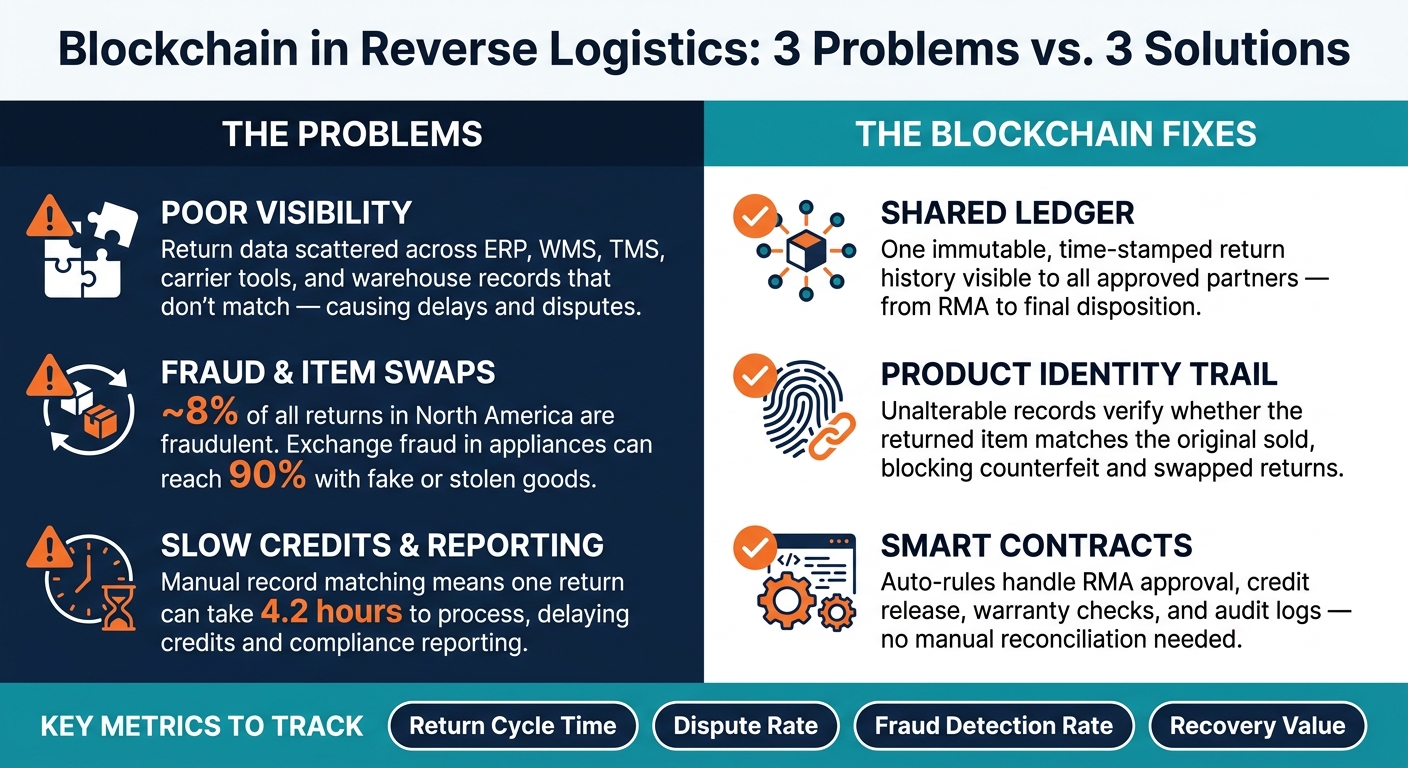
Blockchain in Reverse Logistics: 3 Problems vs. 3 Solutions
Most reverse logistics issues come back to three stubborn problems: poor visibility, fraud risk, and slow settlement.
ERP, WMS, and TMS data often sit in separate places. When that happens, teams lose sight of where an item is, how it was handled, and whether its weight checks line up. That slows disposition decisions and sparks disputes.
Those missing links also drag out fraud checks and final disposition.
In North America, about 8% of all returns are fraudulent. Exchange fraud can be especially high in mobile phones and appliances.
When there’s no shared proof of product identity, it becomes hard to verify that the returned item is the same one that was shipped in the first place. It may have been swapped, opened, or altered in some other way.
A lot of companies still lean on manual review and manual blocklists. The problem is simple: people can only check so much, and results depend heavily on time, staffing, and training. In many cases, retailers don’t spot the fraud until the item has already moved through the full reverse chain and made it back to the original manufacturer. By then, the shipping and inspection costs have already been spent.
And once that delay starts, it usually spills into approvals and settlement too.
Settlement slows down when teams have to inspect items and match invoices across disconnected systems. In some cases, one return can take 4.2 hours to process.
Credits may also go out before the item’s condition is confirmed. Or they get held up while teams try to reconcile records across separate systems. The result is pretty clear: slower approvals, more labor, and more uncertainty right where reverse logistics needs clean, trusted decisions.
The three issues above - fragmented records, fraud risk, and slow settlement - line up with three parts of the reverse logistics process that blockchain can improve. At a basic level, blockchain creates one shared return history and can automatically trigger approved actions.
Right now, warehouses, carriers, and internal teams often keep separate pieces of the return record. Blockchain swaps that patchwork for a single distributed ledger that every authorized party can view in real time. Each event - RMA creation, pickup, receipt, inspection, and disposition - becomes an immutable record.
That matters when things go sideways. If a carrier and a warehouse argue about when damage happened, the ledger shows where the item was and what condition it was in at each handoff. Add IoT sensors, and the record can also include location and in-transit condition data, which makes those disputes much easier to sort out.
Once everyone works from the same record, verifying product identity gets a lot simpler.
When a return arrives, the big question is simple: does the item match the original product? Blockchain helps answer that by tying each product’s identity to an unalterable chain of records that tracks prior repairs, returns, and condition assessments.
This becomes even more useful in categories with high fraud. A 2021 Ethereum-based test for household appliances showed that a digital footprint can verify ownership and block counterfeit or parallel-import returns without manual review.
The same record also helps teams decide what to do with the item next. If the ledger shows that a product was repaired or returned before, warehouse staff can make a better call on whether to restock, repair, liquidate, recycle, or salvage it.
Once identity is confirmed, smart contracts can handle the next move.
Smart contracts are business rules written into code on the blockchain. When a return request comes in, the contract checks ownership and warranty status and then approves or rejects the RMA automatically. After the warehouse confirms receipt and logs the inspection result on the ledger, the contract can trigger the right credit or chargeback without someone having to reconcile records across different systems. That cuts settlement time.
For compliance, each transaction is time-stamped and immutable, which makes the ledger audit-ready for recycling and disposal records.
The next step is implementation: what data, access, and system connections make blockchain usable in reverse logistics? Blockchain only works when the process, data rules, and partner responsibilities are clearly set. In reverse logistics, that means lining up RMA approval, customer pickup, transport, and disposition so teams can deal with scattered records, fraud, and slow settlement. The first thing you need is a shared data model.
Blockchain setup depends on a shared data standard. If item IDs change from one system to another, the ledger can't follow returns with accuracy. Partners need to agree on consistent item identifiers, event definitions, and disposition codes.
That data also has to flow back into day-to-day systems. Return events logged on the ledger should sync with ERP, WMS, TMS, and returns management systems so inventory counts, credits, and shipment status stay up to date.
Once the data model is consistent, governance decides who can do what on the ledger.
A reverse logistics blockchain needs clear access rights across manufacturers, retailers, logistics providers, and regulators. Teams need firm rules on who can open a return, confirm receipt, and release credit before smart contract rules are locked in.
For U.S. operations, permissioned blockchains are the practical option. They limit access to verified partners, protect sensitive customer data, and still give carriers and warehouses the visibility they need. Use encryption and role-based access in a permissioned network to protect customer and shipment data. A regulator role can review disputes and record resolutions.
When the data model is set up and partner rules are clear, blockchain can deliver measurable value in reverse logistics. It makes the most sense when fraud risk is high, manual work is heavy, and visibility across partners is poor.
The payoff shows up in numbers: faster return cycles, fewer disputes, higher recovery value, and cleaner audit trails.
The clearest win is fraud control. That’s where the business case gets easiest to see. Blockchain adds immutable product identity and ownership records, cutting down on manual review and stopping counterfeit or swapped returns. Exchange fraud in large appliances can reach 90% with fake or stolen goods.
Success depends on a few plain things working together:
To measure impact, track return cycle time, dispute rate, fraud detection rate, and recovery value. That’s where blockchain starts turning reverse logistics data into action.
Blockchain makes sense for returns when the goal is to cut fraud, improve transparency, or automate processing.
Its immutable, decentralized ledger can verify ownership and product history. That helps reduce return fraud and cuts down on manual inspection.
Smart contracts can also automate return workflows and document terms and conditions. In plain English, that means fewer disputes and faster refunds.
Businesses can store fixed records about a product’s path and ownership. That includes where the product came from, what it’s made of, and details tied to the exact item being returned.
The blockchain also records every return, refund, and exchange, along with ownership checks that help cut fraud and counterfeiting. With digital product passports and RFID, stakeholders can follow the item from the moment a return starts all the way to restocking, recycling, or disposal.
Blockchain helps cut return fraud by keeping immutable, tamper-proof records of transactions, product movement, and ownership. That gives merchants a clear way to verify returned items and confirm the original purchase details, which helps stop counterfeit returns and product swaps.
Smart contracts can also automate return authorizations. They check return details against the original purchase data, which cuts manual work and reduces human error.


.png)


