Logistics
AI chatbots are reshaping customer support in third-party logistics (3PL). Here's why they matter:
Companies like Riverhorse Logistics have successfully integrated AI chatbots into their eCommerce fulfillment operations, reducing costs, improving efficiency, and enhancing customer satisfaction. By 2029, 80% of common customer service issues in logistics are expected to be resolved autonomously, making AI chatbots a game-changer for the industry.
Third-party logistics (3PL) providers often encounter recurring challenges that affect how efficiently they operate and how satisfied their customers are. These issues highlight the growing need for smarter support solutions, like AI chatbots, to improve workflows and service quality.
One major hurdle in 3PL customer support is the delay caused by manual data retrieval. When customers ask about shipment updates or inventory status, agents often have to search across multiple disconnected systems - such as a Transportation Management System (TMS), Warehouse Management System (WMS), and Customer Relationship Management (CRM) platform. This lack of integration turns simple requests into time-consuming tasks, eating up a large portion of an agent's day.
As Fulfillor aptly states:
"In logistics operations, delays in information are just as damaging as delays in delivery" – Fulfillor
In freight brokerage, delays in responding to inquiries can lead to immediate business losses, as clients may turn to quicker competitors. Adding to the issue, many support teams have limited operating hours, which further frustrates customers.
Traditional customer support teams work in shifts, which means they’re often unavailable during evenings, weekends, or holidays. This creates a significant problem for global logistics networks that operate across various time zones. For instance, if an international client submits a shipment inquiry at 9:00 PM EST, it might not be addressed until the next business day. Such delays could jeopardize crucial processes like customs clearance or on-time pickups.
Offering round-the-clock human support is expensive and comes with its own challenges. Call centers in this sector face an annual turnover rate exceeding 35%, and wages for customer service representatives in transportation and warehousing rose by 12% between 2023 and 2025. On the other hand, 74% of users prefer chatbots because they provide instant answers without the hassle of waiting in phone queues. These factors make automated solutions an appealing alternative for ensuring 24/7 availability while controlling costs.
Repetitive inquiries, particularly "Where Is My Order" (WISMO) questions, make up 40% to 60% of all incoming support requests. These questions typically require agents to share tracking details that customers could easily find on their own. This inefficient cycle not only inflates costs but also prevents support teams from focusing on complex, high-priority issues that truly need human expertise.
AI chatbots are transforming 3PL (third-party logistics) customer support by tapping directly into operational systems that house real-time data. Instead of relying on agents to sift through multiple platforms, these chatbots integrate seamlessly with Transportation Management Systems (TMS), Warehouse Management Systems (WMS), and Enterprise Resource Planning (ERP) platforms. They also connect with carrier APIs like FedEx, UPS, and DHL to fetch live tracking updates and transit details. This connectivity lays the groundwork for smoother operations and improved efficiency.
When a customer asks, "Where's my order?", AI chatbots use natural language processing to interpret the question and pull data from various systems instantly. This real-time access ensures customers receive accurate answers without delays or the need for agents to toggle between screens. Beyond just retrieving information, these chatbots can take action within the systems - like updating delivery addresses, rescheduling appointments, or initiating claims. Some even integrate directly into Warehouse Management Systems, giving teams immediate access to inventory and order details.
AI chatbots excel at taking over repetitive, high-volume tasks. For example, they can reduce "Where is my order?" (WISMO) inquiries by up to 70%, allowing human agents to focus on complex issues such as customs paperwork or billing disputes. The cost savings are significant too - while a manual interaction can cost $5.00 to $12.00, AI-driven interactions range from just $0.50 to $1.50. Additionally, automating claims intake processes has sped up processing times by 40–60%. Chatbots guide customers through structured data collection - like uploading photos and documents - within a single session.
AI chatbots also shine when it comes to multichannel support. They provide consistent service across platforms like web chat, email, SMS, WhatsApp, and even voice interfaces. Conversations retain their context across channels, so a claim started on WhatsApp can seamlessly continue on a web portal. Chatbots also offer tailored visibility for various parties, including shippers, consignees, and brokers. With 24/7 multilingual support in languages like Spanish, Portuguese, French, and German, they ensure accessibility for global customers. Proactive notifications via SMS or email alert customers to potential delays, cutting inbound inquiries by 25–35%. These features collectively lead to faster responses, uninterrupted support, and notable cost reductions.
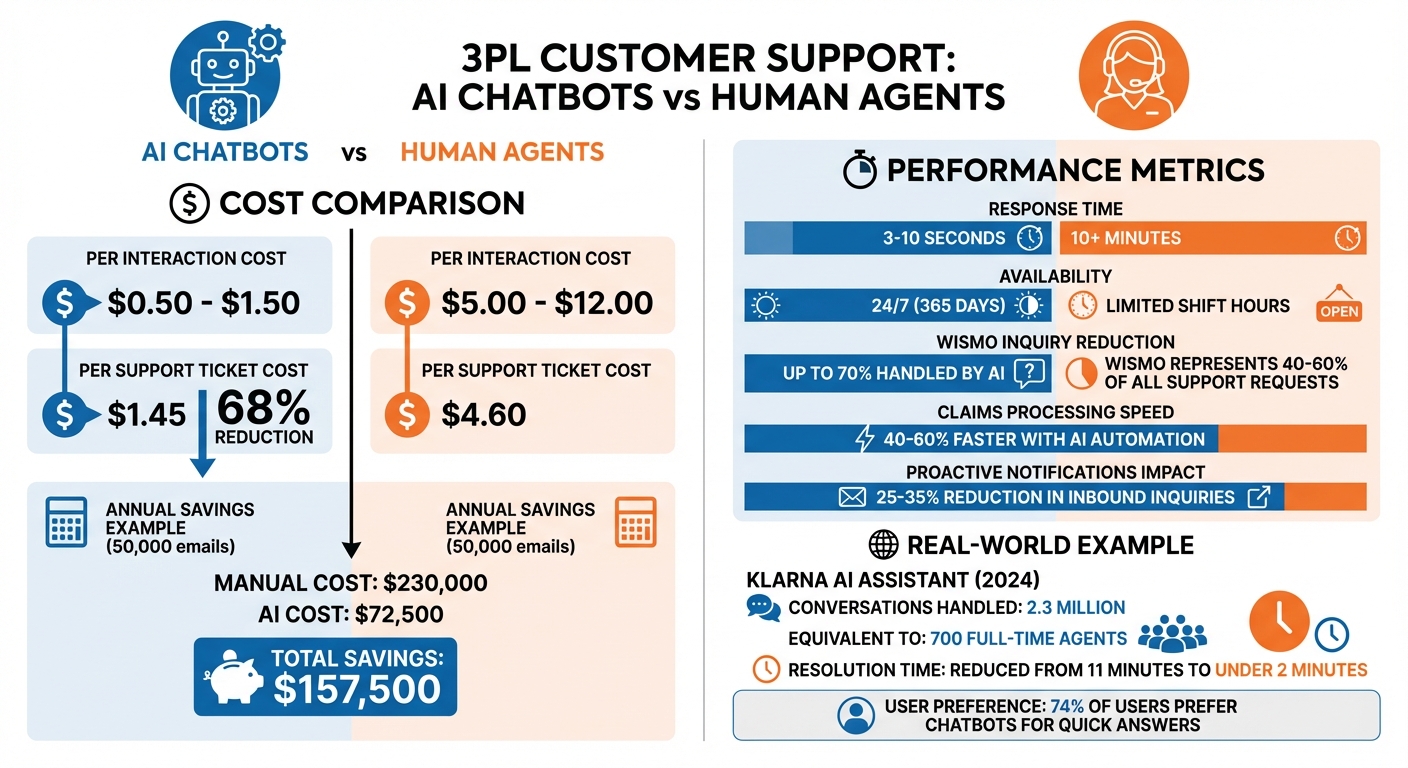
AI Chatbot vs Human Agent Cost Comparison in 3PL Customer Support
AI chatbots are proving to be game-changers for customer support in the 3PL (third-party logistics) industry. By addressing long-standing challenges like slow response times, limited availability, and high operational costs, they’re redefining how 3PL providers interact with their customers. Let’s break down the key advantages.
Gone are the days of waiting on hold or refreshing your inbox for an email reply. AI chatbots deliver answers in seconds by instantly pulling live data. Whether it’s tracking a shipment, checking carrier updates, or providing estimated delivery times, these bots handle it all in real time. For instance, if a customer asks, "Where’s my shipment?", the chatbot can immediately provide the details.
A great example of this efficiency is Klarna’s AI assistant, which, in 2024, managed approximately 2.3 million customer conversations. This was equivalent to the workload of 700 full-time agents and slashed resolution times from 11 minutes to under 2 minutes.
Global supply chains don’t sleep, and neither do AI chatbots. These bots provide support around the clock, eliminating the need for shift-based staffing or region-specific teams. Whether it’s a shipper in Tokyo or a customer in New York, help is always just a message away.
Chatbots also proactively notify customers about potential issues, like weather delays or port congestion, which can reduce inbound inquiries by 25–35%. It’s no wonder that 74% of users prefer chatbots for quick answers, appreciating their ability to bypass long wait times.
AI chatbots aren’t just fast - they’re cost-effective. Manual customer service interactions cost around $4.60 per ticket, while AI-driven interactions cost just $1.45 per ticket. That’s a 68% reduction. For a mid-sized operation handling 50,000 emails annually, this could mean cutting support costs from $230,000 to $72,500, saving $157,500 every year.
"Brands are accelerating their use of AI agents to handle a larger share of routine service work, especially as operating costs rise due to new tariffs and inflation."
– Puneet Mehta, CEO and Founder, Netomi
Real-world examples show the impact. Outlines, a home goods startup, uses an AI chatbot to handle up to 70% of its support tickets, saving about $5,000 monthly on outsourced customer service. Similarly, Absolutely Ridiculous, a softball equipment manufacturer, reassigned its entire support team to growth-focused roles after deploying an AI agent, leaving only one intern to oversee the system.
These success stories highlight how AI chatbots not only save money but also free up human teams to focus on bigger, more strategic tasks. Companies like Riverhorse Logistics are leveraging these efficiencies to set new standards in 3PL customer support.
Riverhorse Logistics has embedded AI chatbots into its TMS, WMS, and ERP systems to provide fast, precise customer support in real-time. This move tackles one of the logistics industry's persistent challenges: WISMO (Where Is My Order) inquiries, which make up 40–60% of inbound customer service requests. By automating these repetitive questions, the company not only ensures 24/7 availability but also allows human agents to focus on resolving more complex issues.
Here’s a closer look at how this integration improves specific logistics services.
For LTL and FTL shipments, the AI chatbots deliver instant tracking updates, including carrier status, ETAs, and scheduling changes. These updates are provided in just 3–10 seconds, a significant improvement over the 10+ minutes typically required for manual responses.
By connecting directly to carrier tracking APIs, the chatbots provide customers with ETAs based on live data rather than outdated batch updates.
The chatbots handle a wide range of eCommerce tasks, from checking inventory and processing orders to managing returns - without requiring human involvement.
In cases of damaged goods, the chatbot gathers all necessary documentation in a single interaction, speeding up claims processing by 40–60%. This efficiency comes with notable cost savings: AI-driven interactions cost just $0.50–$1.50 each, compared to $5.00–$10.00 for manual support calls.
By integrating directly with ERP, WMS, and TMS platforms, the chatbots create a "single source of truth" that ensures consistent and accurate information across systems.
"AI chatbots built directly into a WMS deliver more value than standalone support bots because they operate on live operational data rather than disconnected systems."
– Fulfillor
AI chatbots are transforming 3PL customer support by offering instant responses, 24/7 availability, and significant cost savings. For instance, they reduce support ticket expenses from $4.60 to $1.45, potentially saving businesses up to $1.68 million annually.
But the benefits go beyond cost reduction. By automating routine tasks like shipment tracking, chatbots free up human agents to focus on more complex problems. This ensures quick response times across all time zones, enhancing overall efficiency.
A great example of this in action is Riverhorse Logistics, which has successfully integrated chatbots into its TMS, WMS, and ERP systems. This integration enables real-time shipment updates and helps manage eCommerce processes seamlessly.
Experts foresee a major shift in logistics driven by AI. Dmitri Koteshov from Mitrix highlights this momentum:
"In logistics, where every second counts and reputation is built on reliability, those who lead with smart chatbot practices position their companies not only to meet demand but to stay ahead of it".
This shift underscores the growing demand for smarter, more efficient customer support in the 3PL sector. The numbers back it up: 74% of users prefer chatbots for quick answers, avoiding the hassle of waiting in support queues. And with Gartner projecting a 30% reduction in operational costs for service organizations by 2029 thanks to agentic AI, early adopters are already reaping the rewards of better efficiency and happier customers.
A 3PL chatbot needs to connect with critical systems such as warehouse management systems, transportation management systems, and carrier APIs. These integrations allow the chatbot to deliver real-time updates on shipment status, inventory levels, and delivery progress. This ensures customers receive accurate information and timely support when they need it most.
AI chatbots excel at managing routine tasks like tracking shipments, checking delivery times, and answering FAQs. They're great at providing fast, efficient responses to a large number of inquiries. But when it comes to more complicated matters - like handling complaints, resolving disputes, or addressing specific customer needs - it's best to pass these on to human agents. Human support brings the ability to exercise judgment and offer a personal touch, which helps maintain customer trust. Meanwhile, chatbots can stay focused on handling simpler, high-volume interactions seamlessly.
To gauge the ROI of chatbots in your 3PL customer support operations, focus on a few key metrics:
These data points together offer a clear view of how chatbots contribute to cost savings, better service, and smoother operations.


.png)


